
fields of activity
COMPOSER
Komitas Vardapet is the founder of the Armenian national school of composition. Drawing upon the developmental experience of Western European music, as well as the achievements of Armenian compositional practice, and through a deep study of the distinctive features of Armenian traditional music, he created a unique compositional style that is unparalleled and inimitable on a global scale. The harmonic and polyphonic manifestations of Komitas’s music, as well as his approaches to texture, do not conform to any established musicological classifications.
Komitas’s creative legacy includes arrangements of Armenian folk and sacred songs, as well as original compositions independent of folk sources. These arrangements are themselves regarded as creative works, given the composer’s distinctive artistic approach. Komitas composed primarily in the following genres:
a) Solo songs with piano accompaniment.
Komitas arranged masterpieces of Armenian folk music—collected through his own fieldwork—for voice and piano. The thematic range is broad, encompassing philosophical, lyrical, and love songs, as well as humorous and dance songs. Some require exceptional vocal mastery, such as “Antuni,” “Krunk,” and “Tsirani tsar.” It is remarkable that these songs were recorded from peasants, indicating their natural vocal skill. Komitas’s original songs, though independent of folk sources, often resemble traditional music so closely that they are perceived as such; a notable example is “Kaqavik.”
b) Choral works.
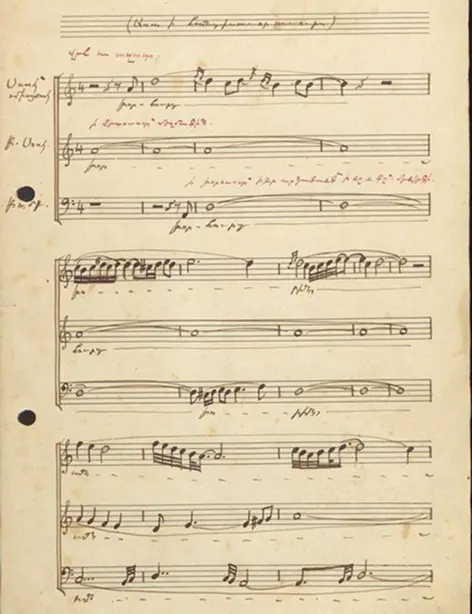
Komitas’s choral output includes arrangements of sacred and folk songs, as well as original compositions. His sacred arrangements correspond to various days of the ecclesiastical calendar, feasts, and saints, including “Songs of the Blessing of Water” and “Songs of the Washing of Feet.” Individual sacred pieces also include sections of the Divine Liturgy, such as “Hayr mer” and “Amen. Hayr surb.”
The Divine Liturgy (Patarag) for male choir is the only large-scale work by Komitas that has survived in full. He developed its melodies over different periods of his life, for various occasions and performing forces. The traditional melodies were primarily drawn from notations recorded by N. Tashjian (published in 1874 and 1878), as well as from orally transmitted sources. Some settings have survived only in fragmentary form. Of particular note is the setting of the New Julfa (Indian-Armenian) liturgy from the 1910s, as well as a version with German translation written in Berlin. The final version for male choir was completed in 1914. Komitas often conceived these liturgical settings as concert works, and today the 1914 Patarag is performed both in concert halls and in liturgical contexts.
Komitas also arranged folk songs for various choral ensembles. These works span multiple genres reflecting aspects of rural life: work songs, wedding songs (including cycles), dance songs, humorous songs, and ritual songs.
c) Piano works.
Among his piano compositions, the most notable are “Seven Dances,” based on dances from different regions of Armenia; “Msho Shoror,” also comprising several dances; and the miniatures titled “Songs,”
based on various folk melodies. These works exhibit a distinctive style characterized by transparency, subtle coloration, and a uniquely “Komitasian” approach to texture.
d) Operatic projects.
Several operatic concepts by Komitas are known, though they survive only in fragmentary form. These include an opera “Anush” (based on the poem by Hovhannes Tumanyan) and “Sasna Tsrer,”
based on the Armenian epic. The thematic choices in these projects further demonstrate his commitment to national culture.
e) Ensemble and orchestral works.
These were composed during his student years and demonstrate his mastery of classical compositional techniques. Among them is the orchestral piece “Walde Nacht.”
These early works reveal his strong command of various classical genres, although he later focused primarily on vocal, choral, and piano music.
Komitas Vardapet placed the collection, classification, and study of traditional music on a scientific foundation. He is considered one of the first ethnomusicologists in the world. Throughout his life, he traveled extensively to various regions, collecting examples of traditional music. He preferred remote villages, where foreign influences were minimal and songs were preserved in their purest form.
This work was extremely challenging, as villagers often refused to sing outside their natural context. As Komitas noted:
“With great difficulty, or not at all, they sing… The people do not know artificial singing. Each song belongs to its place and time… No villager will sing a plowing song while sitting at home…”
Despite these challenges, Komitas succeeded in recording thousands of examples of Armenian traditional music, thus saving them from oblivion. These include masterpieces of sacred and folk music such as the epic “Mokats Mirza,” sung fragments of “Sasna Tsrer,” exile songs like“Krunk,” work songs such as “Lori Plowing Song,” the lament “Tiramayrn,” and the sharakans of Gregory of Narek.
One of the most important aspects of Komitas’s activity was his musicological work. He presented the results of his research to various audiences, including at congresses of the International Music Society. His studies of Armenian sacred and folk music led to several fundamental conclusions and discoveries:
-The importance of historical-geographical and social factors in shaping music (including geography, climate, and language).
- The classification of musical genres.
- The identification of Armenian modal systems, which differ structurally from those of European music.
- The clarification of structural principles.
- The study of khaz notation, the medieval Armenian system of musical notation (in use from the 8th to the 18th century). Komitas succeeded in identifying the key to deciphering the khazes.
- Comparative research on the music of neighboring peoples (Armenian, Persian, Kurdish, Turkish, Arab, and Assyrian), identifying distinctive national characteristics
PERFORMER
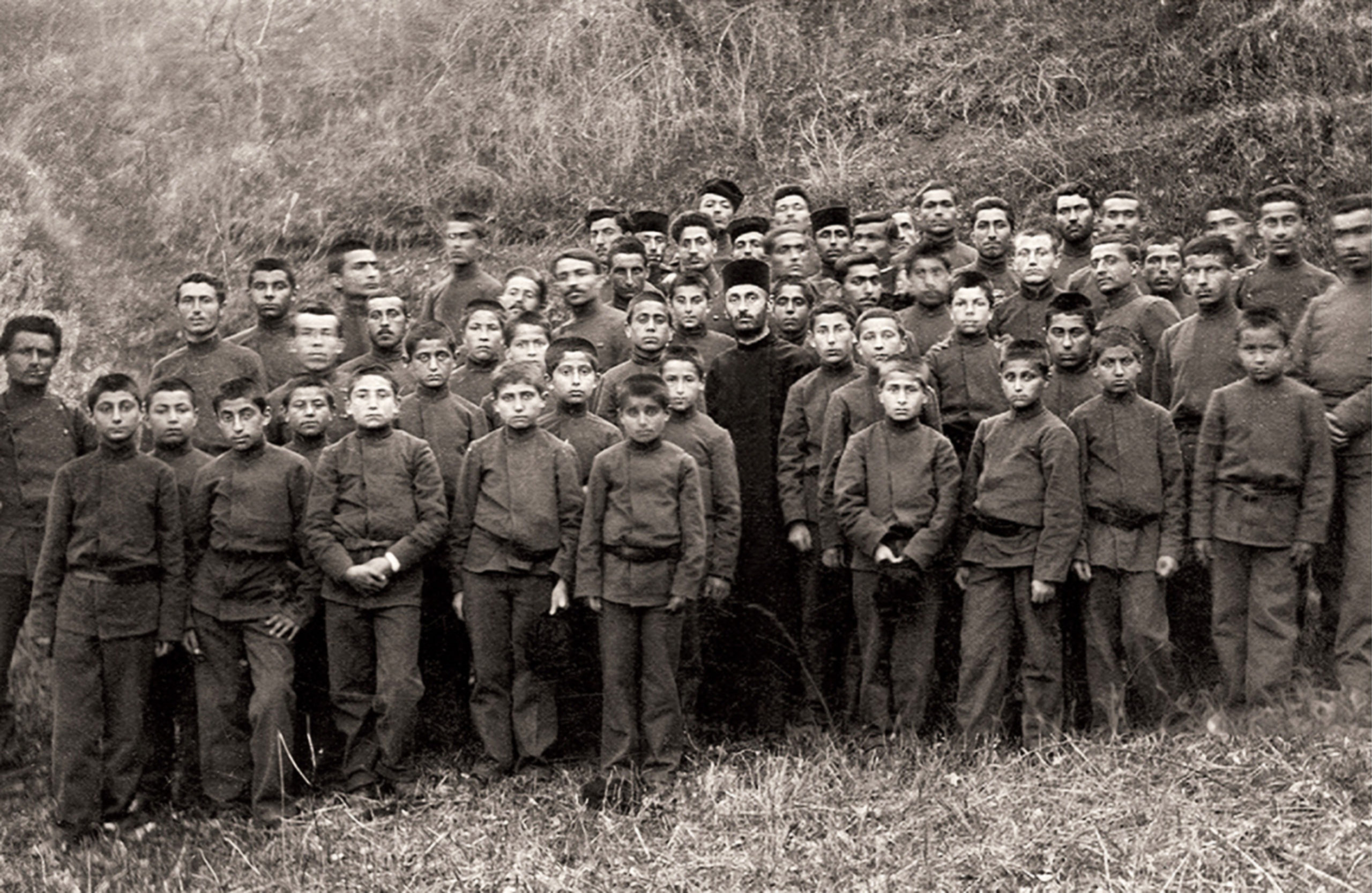
Komitas was both a singer and a conductor. His performances—whether as a soloist or as a choral leader—had a profound impact on audiences. Numerous accounts attest to the exceptional beauty of his voice, capable of moving listeners to tears. Recordings of his singing made in Paris in 1912 have been preserved.
PEDAGOGUE
Komitas taught at the Gevorgian Seminary and later gave private lessons in Constantinople. He aspired to establish a conservatory there; although this goal remained unrealized, he trained a generation of talented students who later played significant roles in Armenian music. Among his students were Barsegh Kanachyan, who became a composer; Vardan Sargsyan, who promoted Komitas’s works; and Mihran Tumajan, who continued folkloristic research.