Biography
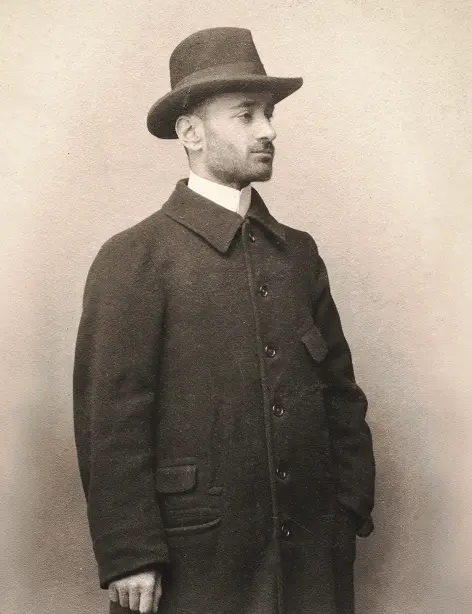
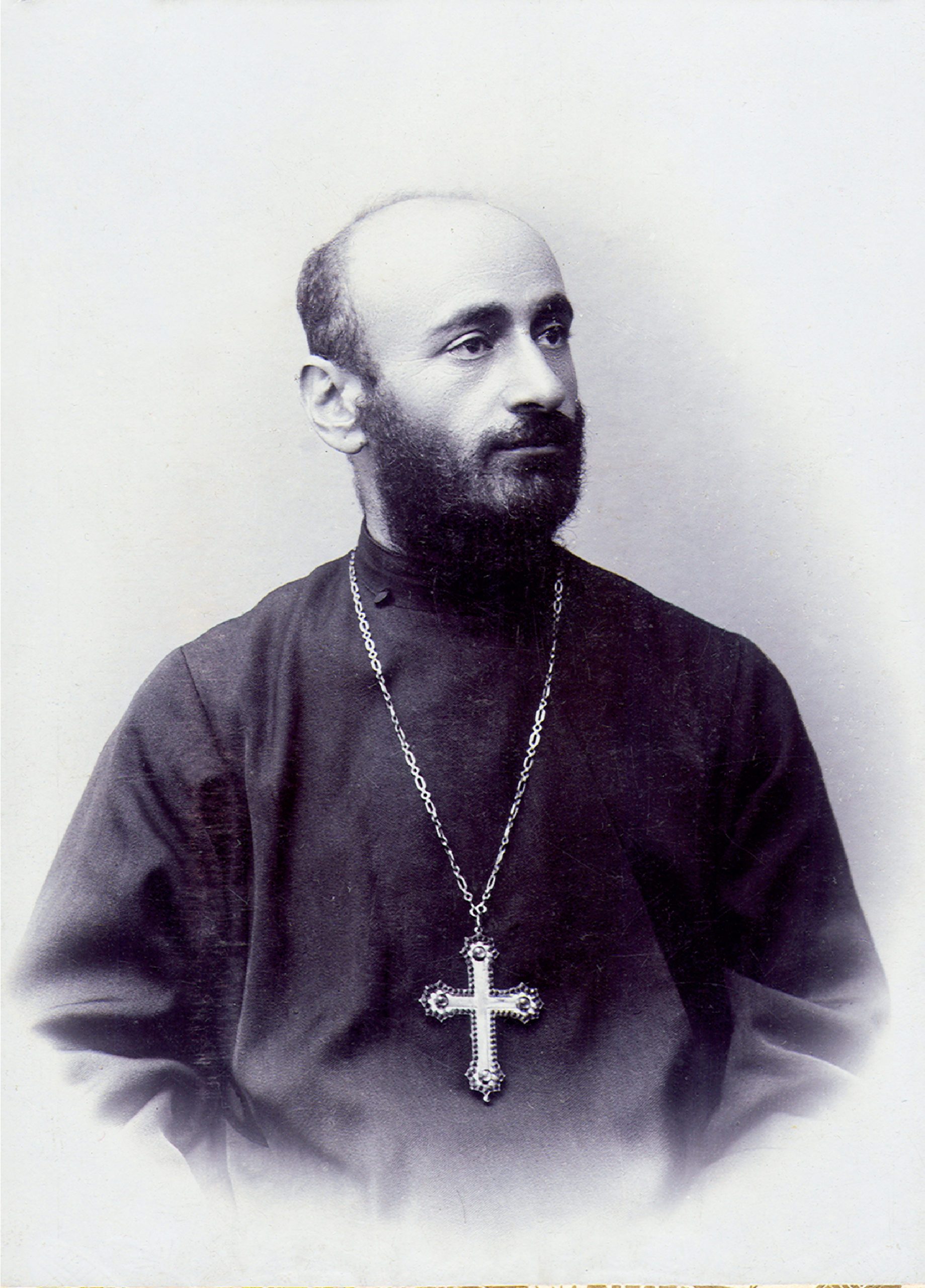
Komitas Vardapet (Soghomon Soghomonyan) was born on September 26 (October 8), 1869, in the city of Kütahya (Kutina) of the Ottoman Empire. His ancestors had migrated to Kütahya at the end of the 17th century from the village of Tsgna in the Goghtn province of historic Armenia.
His father, Gevorg Soghomonyan, and his mother, Taguhi Hovhannisyan, were both gifted with beautiful voices and composed songs that became beloved and deeply rooted in the musical life of Kütahya.
Komitas lost his mother in 1870 and his father in 1880. After being orphaned, he was first cared for by his paternal grandmother Mariam, and after her death, by his aunt. From 1876 to 1880 he studied at the four-grade school of Kütahya, and later at the boarding school in Bursa.
In 1881, the locum tenens of the Kütahya Diocese, Archimandrite Gevorg Derdzakian, traveled to Etchmiadzin to be ordained bishop. According to the encyclical of Catholicos Gevorg IV of All Armenians, he was required to bring with him a gifted orphan boy to study at the Theological Seminary of Holy Etchmiadzin (later, the Seminary was renamed after its founder). Among nearly twenty orphans, Soghomon was chosen.
From 1881 onward, Soghomon Soghomonyan studied at the Gevorgian Seminary, where he distinguished himself through his exceptional musical abilities and beautiful voice. During his years of study (1881–1893), his extraordinary musical talent—evident since childhood—fully emerged. Under the guidance of Archimandrite Sahak Amatuni, he mastered the theoretical and practical foundations of Armenian sacred music. During this period, he began collecting and studying Armenian folk songs and made his first attempts at composition.
After graduating in 1893, Soghomon was appointed teacher and choirmaster at the Mother Cathedral. In 1894 he was ordained a celibate priest and received the name Komitas, after the 7th-century poet, hymnographer, and Catholicos Komitas Aghtsetsi. In 1895 he was granted the ecclesiastical rank of Vardapet (Doctor of Theology).
In 1895–1896 Komitas briefly studied music theory in Tiflis under the composer Makar Yekmalyan. In 1896, with a scholarship provided by the prominent oil magnate and philanthropist Alexander Mantashyants, he departed for Berlin to continue his education. From 1896 to 1899 he studied at Richard Schmidt’s private conservatory and at the Faculty of Philosophy of Friedrich Wilhelm University (renamed Humboldt University in 1949). His teachers included leading musicologists such as Oskar Fleischer, Heinrich Bellermann, and Max Friedlaender. He studied composition theory, music history and theory, conducting, psychology, and philosophy, trained his voice, and learned to play the piano and organ.
In 1899 Komitas became one of the first members of the newly founded International Music Society. At the meetings of its Berlin branch, he delivered lectures and reports on Armenian sacred and secular music. During these years, he composed songs, romances, and choral works on texts by German poets and arranged folk songs.
Upon returning to Etchmiadzin, Komitas Vardapet continued his scholarly, folkloristic, and pedagogical activities. He devoted himself to the transcription and scientific study of Armenian folk and sacred music. With the seminary’s four-part choir, he gave concerts in Etchmiadzin, Yerevan, Tiflis, and Baku. He also persistently worked on deciphering the medieval Armenian musical notation system—khaz notation.
In 1907, Komitas published the collection Armenian Lyre (Hay Knar) of folk songs at the E. Démey publishing house in Paris. He delivered lectures on Armenian music in numerous cities across Europe and the Middle East, including Paris, Berlin, Zurich, Geneva, Lausanne, Venice, Constantinople, Alexandria, and Cairo. His presentations were met with enthusiastic acclaim and high praise from leading intellectuals and musicians of the time, such as Louis Laloy, Romain Rolland, Egon Wellesz, Camille Saint-Saëns, and Amédée Gastoué.
In 1910 Komitas moved from Etchmiadzin to Constantinople, considering its cultural environment more favorable for his future work. There he founded the mixed choir Gusan, numbering around 300 singers, and gave concerts in various cities. He continued his scholarly and pedagogical work, published articles, and taught music theory to choir members with the aim of training professional musicians. Among his students—later known as the “Five Disciples of Komitas”—were Barsegh Kanachyan, Mihran Toumajan, Vardan Sarxyan, Vagharshak Srivandztian, and Haig Semerdjian. He also envisioned the establishment of a conservatory for Armenian youth.
In 1912, Komitas’s collection Armenian Folk Songs, featuring solo and choral arrangements, was published by the prestigious Breitkopf & Härtel publishing house in Leipzig. In 1914 he participated in the Fifth Congress of the International Music Society in Paris, presenting three papers on Armenian sacred music, folk music, and khaz notation. His monumental late work, Patarag (Liturgy) for male choir, stands as a pinnacle of his artistic legacy.
The Armenian Genocide organized and carried out by the Ottoman Empire in 1915 tragically interrupted the life and work of the great musician. Along with other Armenian intellectuals of Constantinople, Komitas was arrested and deported to the interior regions of Turkey, to Ayash and Chankiri. Although he was eventually brought back through the intervention of the American ambassador Henry Morgenthau and other influential figures, the trauma he endured shattered his mental health, and he ceased composing.
From 1916 to 1919, Komitas was hospitalized at the French military psychiatric hospital La Paix in the Şişli district of Constantinople. The final sixteen years of his life were spent in medical institutions in the Paris suburbs of Ville-Évrard and Villejuif.
Komitas Vardapet passed away on October 20, 1935, in Paris. One year later, his remains were transferred to Yerevan and laid to rest in the Pantheon of Armenian cultural figures, which has borne his name since 1936.
On January 29, 2015, the Komitas Museum-Institute was inaugurated in Yerevan. The institution is dedicated to the preservation, study, and dissemination of the creative and scholarly legacy of Komitas Vardapet.